Balcony Rail Planter or Floor Pot for a Narrow Strip?
Compare a balcony rail planter or floor pot by sightline, walking room, and plant care to choose a layout that keeps your small outdoor space usable.
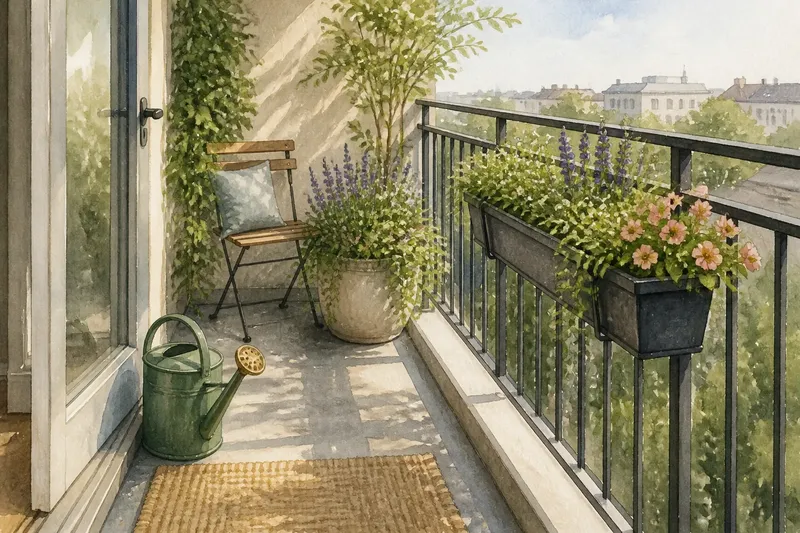
A watering can sits beside the balcony door, while a floor pot makes the walk to the railing a sidestep. Choosing a balcony rail planter or floor pot for a narrow strip depends on how you use the space, what you grow, and what the balcony can safely support.
Both options can hold herbs, flowers, or compact foliage. A rail planter keeps its growing area above the floor; a floor pot claims a patch of walking surface. Before shopping, consider the route, sunlight, watering access, and building rules.
Keep the balcony route clear
If you carry laundry, open a balcony door outward, or move a chair along the rail, the floor is already doing useful work. A rail planter may suit the layout because it leaves the walking surface open. This is especially helpful when the balcony is a passage to the view rather than a place for several furnishings.
A floor pot makes more sense in a stable corner or unused end of the strip. It can be moved for sweeping or rearranging, but moving it is a task, not a substitute for keeping a comfortable path. Choose a shape that fits without forcing a tight turn.
Imagine a balcony with a door at one end and a folding chair at the other. The hypothetical starting point is a clear route between them, with a planter-sized empty corner beside the chair. If the chair folds away but the route must stay open, choose a rail planter and keep the floor clear. If the chair is rarely used and the corner stays empty, set a floor pot there and walk the route again; the observable result should be an unobstructed passage, though the plants will sit farther from the railing.
Walk your usual route before choosing a planter.
Check the view and growing conditions
A rail planter brings foliage close to the balcony edge and may soften the railing from indoors or the street. Tall or dense plants can also interrupt a seated view. Think about which sightline matters: the view from a chair, the appearance from inside, or the outlook from neighboring windows.
Floor pots leave the railing more visible. A low arrangement can bring greenery into view from a chair while keeping the horizon open. A taller pot may screen a particular corner, but it can feel like an obstacle if it sits between the door and the rest of the balcony.
Sun and wind matter as much as placement. Note where direct light falls and whether the rail is especially exposed. Match plant choices to those conditions, and check the care label for watering needs. A position that is easy to tend is more useful than one that looks attractive but is difficult to reach.
Look from your usual seat, then check the light where the plants would grow.
Compare the full footprint and access
A rail planter uses little floor area, but its working footprint includes the container, its attachment, and the space needed to reach it for watering and care. Consider whether you can tend the plants from inside the balcony without leaning over the railing. A floor pot occupies a visible patch, yet can often be placed where the watering can and your hand can reach it easily.
Balcony rails and building rules differ. Before attaching anything, check the property’s requirements and the planter maker’s instructions. If the rail’s condition or a proposed attachment is uncertain, ask the property manager or a qualified professional rather than improvising a fix.
- Check the walking route: If a floor pot would interrupt your usual passage, choose a rail planter if the rail and rules allow it; otherwise leave that area unplanted.
- Check for a stable corner: If a corner holds a pot without narrowing the route, consider a floor pot; if not, keep the floor clear.
- Check the seated sightline: If a rail planter would block a view you use, choose a low floor arrangement; if the floor pot blocks the route instead, use a compliant rail planter or skip that position.
- Check the light and exposure: If the proposed spot suits the plants’ care needs, plant there; if it is too shaded or exposed, choose plants suited to it or another location.
- Check watering access: If you can reach the plants comfortably from inside, keep that position; if care requires leaning over the rail, relocate the planter or choose a safer setup.
- Check the rail and property rules: If the attachment is permitted and the rail is suitable, follow the maker’s instructions; if either point is unclear, ask the property manager or a qualified professional and use a floor pot only where it does not obstruct the route.
Which planter fits your balcony?
Is a rail planter better for a very narrow balcony?
It can preserve floor space when the walking strip must stay open and the rail is suitable for the planter. It is not a good fit if it interferes with a door, a handhold, a useful view, or safe access.
Are floor pots easier to move?
They can be repositioned without changing the railing, but a filled pot may be awkward to lift. Choose a location you can use comfortably rather than assuming you will move the pot whenever the floor feels crowded.
Can I use both a rail planter and a floor pot?
Yes, if each has a distinct place and the walking route remains comfortable. A modest rail planting paired with one corner pot may suit the space better than planting along every edge.
What should I choose if I want privacy?
Either arrangement can soften a particular sightline, depending on plant height and density. Place it to screen the angle you mind without obstructing access or a view you want to keep.
Choose the setup you can tend comfortably
For a narrow balcony used mainly as a passage, a rail planter may preserve the floor area. For a balcony with a dependable corner and a clear route, a floor pot gives plants a grounded position and leaves the railing unobstructed. If both needs matter, one of each may be enough, provided the attachment, placement, and care access all work.
To decide between a balcony rail planter or floor pot, put an empty box or folded towel where the floor pot might stand. Walk through, open the door, and sit in your usual place. Then check whether you can water the proposed plants without awkward reaching; the better layout is the one that keeps those ordinary routines comfortable.