Window Boxes and City Balconies: How Urban Planting Took Shape
Window boxes and city balconies make small urban spaces greener; learn how their design shapes planting choices and how to adapt containers to daily life.

A geranium leans over a sill above a busy avenue, its leaves catching the light between passing buses. Window boxes and city balconies bring plants close to urban homes, but their story is less a single historical progression than a set of practical responses to different buildings, climates, and household routines. Without a place-specific record, it is better to describe those uses than to assign them a universal origin.
Window boxes make use of a building’s edge
A window ledge can hold a pot or trough where there is no yard. The arrangement fits the opening already built into the home, keeping plants visible from indoors and outdoors while leaving the floor clear. Residents might use that space for herbs, flowers, or a container that can be brought inside when conditions require it.
The form depends on the building. A broad sill can support a freestanding pot; a narrow ledge may call for a secured box or may not be suitable for planting at all. Materials and methods vary, so the presence of a window does not by itself establish what residents historically grew there or how common the practice was in a particular place.
Start with the ledge and the household routine, not an imagined garden.
Balconies give planting a different kind of room
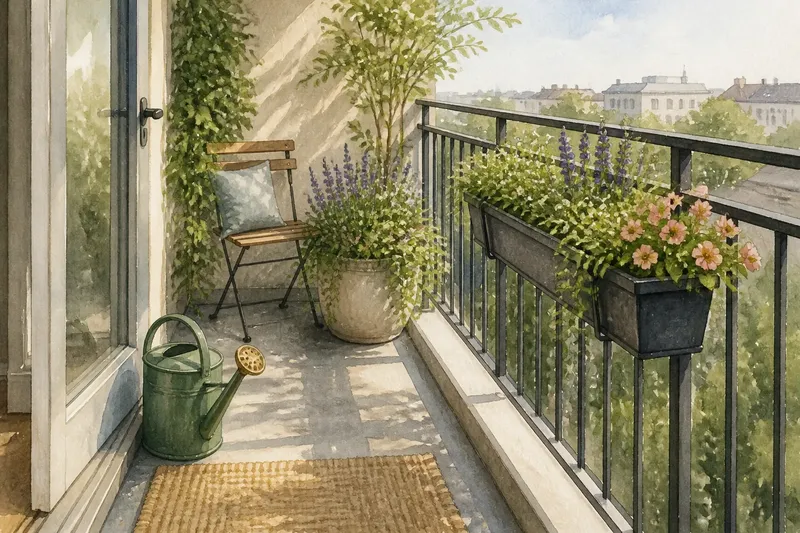
A balcony extends beyond the window frame, giving residents space to stand, sit, and arrange containers. Its role is not fixed: the same area may be used for fresh air, laundry, storage, or plants. Any account of balcony planting therefore needs to allow for local building designs and household habits rather than treating all balconies as gardens.
The change in space also changes the conditions. A balcony can expose containers to stronger wind and rain than a recessed window, while nearby buildings may shade it. Railings, floor loads, drainage, and shared building rules can limit what belongs there. The architecture shapes the options before a resident chooses a plant.
Notice how the space is used through the day before deciding what belongs there.
Urban planting reflects both private use and shared views
A planter is tended by someone at home, but its effects can reach beyond that home. Flowers may be visible from the street or neighboring windows; spilled water, loose leaves, or an insecure container can affect other residents. These observations support a modest point: planting in a shared building calls for attention to the setting as well as the plants.
Meaning varies from one place to another. In some buildings, residents may treat a balcony as a private retreat. Elsewhere, window displays may be part of a street’s familiar appearance. Without specific local evidence, neither use should be presented as a universal tradition or a documented historical turning point.
Consider both the view from indoors and the view from below.
Choose containers around the building’s limits
Before buying a planter, identify the practical constraints. Check the building’s guidance and the container maker’s instructions, especially for anything attached to a facade or railing. If a container could fall, or if a balcony’s capacity is uncertain, ask building management or a qualified professional rather than guessing.
- Observe the ledge or railing. If the surface is broad, stable, and permitted for a freestanding container, choose a pot that sits securely; if it is narrow or exposed, use an approved attachment or keep planting indoors.
- Observe where water goes after watering. If runoff stays contained, continue with that setup; if it reaches a neighbor’s space or the sidewalk, use a suitable saucer or change the watering method.
- Observe sunlight and shade at different times. If the spot receives the light a chosen plant needs, keep it there; if nearby buildings leave it shaded, select a shade-tolerant plant or move the container.
- Observe how strongly wind reaches the container. If stems and pots remain sheltered, maintain the position; if wind rocks the pot or stresses the plant, move it to a protected location or choose a more stable, approved container.
- Observe whether routine care is comfortable to reach. If watering and pruning can be done without leaning dangerously or blocking a doorway, keep the arrangement; if not, move pots within easy reach or reduce the number of containers.
- Observe whether the planting conflicts with building guidance. If the placement and attachment are allowed, proceed within those conditions; if rules are unclear or prohibit it, ask building management or choose an indoor location.
- Observe whether leaves or flowers collect around drains and walkways. If the area stays clear, continue ordinary upkeep; if debris gathers, remove it regularly or relocate the planter away from the affected route.
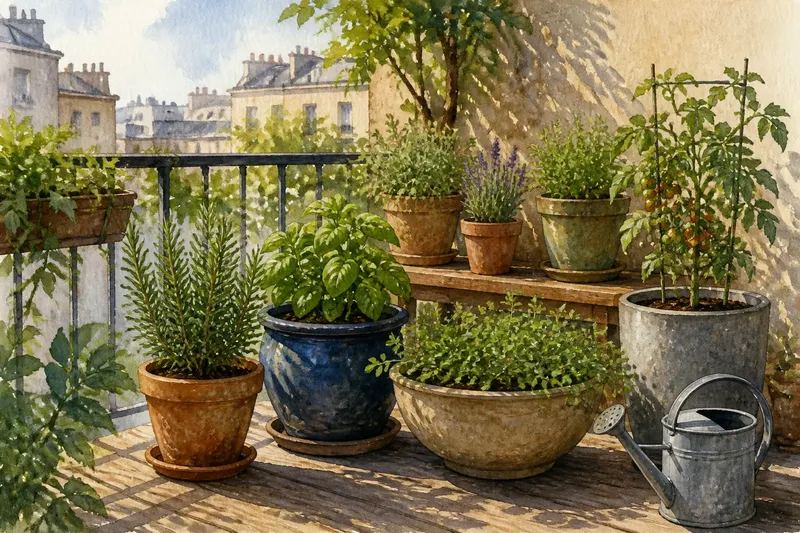
Say a resident has two hypothetical pots on a balcony: one sits beside a sheltered wall, the other beside an exposed railing, and both dry out while the watering can is kept across the room. The resident checks building guidance and finds that freestanding pots are allowed but railing attachments are not; checks the balcony at different times and sees that the wall is shaded while the railing gets direct sun; then moves the sun-loving pot to a stable spot near the wall’s outer edge, keeps the other in shade, and places the watering can by the door. The resulting decision is to keep both pots freestanding and easy to reach, while watching for wind and runoff before making further changes.
For anything that could fall, follow building requirements and product instructions. Ask building management or a qualified professional if the support or permitted load is uncertain.
Small plantings still follow the shape of the home
Window boxes and city balconies remain useful places to keep plants close to daily life, but the details depend on the building. Lightweight pots may suit a sill; a balcony may accommodate several containers if its rules and conditions allow. Shared courtyards and terraces add another consideration: residents need agreement about access, watering, and upkeep.
The practical continuity is simple. A ledge or balcony becomes a growing place only when its exposure, access, and shared responsibilities fit the household’s routine. Keep the arrangement modest enough that care remains manageable.
What should residents know about window boxes and city balconies?
Why do people use window boxes?
A window box makes use of a ledge where a yard or garden plot is unavailable. It can keep flowers or other plants close to a room, provided the sill and attachment are suitable.
How does a balcony differ from a windowsill?
A balcony offers space to stand and arrange containers beyond the window opening. It can also bring greater exposure to wind and rain, so placement and building rules matter.
Are window boxes always safe to attach?
No. The ledge, attachment, building rules, and risk of falling all matter. Check the applicable instructions and ask building management or a qualified professional when support is uncertain.
What should be checked before adding a planter?
Check light, wind, access for care, water runoff, and any building guidance. Window boxes and city balconies work best for planting when the container suits those conditions and does not create problems for neighbors.